Practice problems - Rolling, Torque , and Angular Momentum
Not what you're looking for?
Rolling, Torque , and Angular Momentum
1. A constant horizontal force of magnitude 10 N is applied to a wheel of mass 10 kg and radius 0.30 m as shown in the figure below. The wheel rolls smoothly on the horizontal surface and the acceleration of its center of mass has magnitude 0.60 m/s^2. ( a) what are the magnitude and direction of the frictional force on the wheel ?
2. Two particles , each of mass m and speed v , travel in opposite directions along parallel lined separated by a distance d. (a) In terms of m, v and d , find an expression for the magnitude L of the angular momentum of the two-particle system around a point midway between the two lines. (b) Does the expression change if the point about which L is calculated is not midway between the lines? (c) Now reverse the direction of travel for one of the particles and repeat (a) and (b)
3. A uniform thin rod of length 0.50m and mass 4.0 kg can rotate in a horizontal plane about a vertical axis through its center. The rod is at rest when a 3.0 g bullet traveling in the horizontal plane of the rod is fired into one end of the rod. As viewed from above the direction of the bullets velocity makes an angle of 60 degrees with the rod (figure below). If the bullet lodges in the rod and the angular velocity of the rod is 10 radians per second immediately after the collision, what is the bullets speed just before impact?
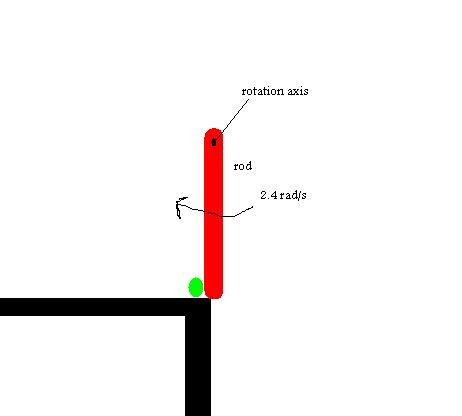
4. (figure below ) A uniform rod (length = 0.60 meters, mass = 1.0 kg ) rotates about and axis through one end with a rotational inertia of 0.12 kg * m^2 . As the rod swings through its lowest position, the end of the rod collides with a small 0.20 kg putty wad that sticks to the end of the rod. If the angular speed of the rod just before the collision is 2.4 radians per second, what is the angular speed of the rod-putty system immediately after the collision?
5. At the instant the displacement of a 2.00 kg object relative to the origin is vector d = ( 2.00 m ) + (4.00 m) - (3.00 m) , its velocity is
vector v = -(6.00m/s) + (3.00m/s) + (3.00m/s) , and it is subject to a force vector F= (6.00 N) - (8.00 N) + (4.00 N) . Find (a) the acceleration of the object, (b) the angular momentum of the object about the origin , (c) the torque about the origin acting on the object , and (d) the angle between the velocity of the object and the force acting on the object.
6. A uniform solid ball rolls smoothly along a floor , then up a ramp at 15 degree's. It momentarily stops when it has rolled 1.50 m along the ramp. What was its initial speed ?
Purchase this Solution
Solution Summary
A set of 6 parctice problems. The solution gives all steps along with proper explanations so that you can solve similar problems yourself.
Solution Preview
Please view the attachment;
<br>I've included comments along with each problem.
--------------only for searh--- -----------
1. A constant horizontal force of magnitude 10 N is applied to a wheel of mass 10 kg and radius 0.30 m as shown in the figure below. The wheel rolls smoothly on the horizontal surface and the acceleration of its center of mass has magnitude 0.60 m/s^2. (a) What are the magnitude and direction of the frictional force on the wheel?
Newton's 2nd law in its linear form can be applied to determine the static friction force;
The acceleration a, the mass M of the wheel, and the applied force Fapplied are given.
Assuming the static friction force Fsf points to the left (so as to oppose the motion) and applying Newton's 2nd law, we get:
Fapplied - Fsf = ma
Fsf = Fapplied - ma = 10 - 10*0.6 = 10 - 6 = 4 N
The direction of frictional force is given in the figure given below
(Also Moment of inertia of the ring shaped wheel, I = mR2 = 10 * 0.32 = 0.9 kg m2
Angular acceleration A = linear acceleration/radius of the wheel = 0.6/0.3 = 2 rad/s2
The applied torque (about the cm) T = force * perpendicular distance = 10 * 0.3 = 3 Nm
Effective torque produced (about the center of mass) T = I A = 0.9 * 2 = 1.8 N m
Tfr = 3 - 1.8 = 1.2 Nm ( T = F * d)
Thus Fr = 1.2/0.3 = 4 N (again)
Since we consider the rotation as being about the center of mass of the object, the frictional force must be in a direction to provide the torque necessary to decrease or increase the angular velocity, depending on whether the object is accelerating or decelerating, respectively. Note that the friction can be in the direction of motion (rolling downhill) or opposite to it (rolling uphill). In pure rolling motion there is no sliding or slipping, thus the contact points have no relative motion (no relative velocity). This results in a frictional force of zero.
2. Two ...
Purchase this Solution
Free BrainMass Quizzes
Intro to the Physics Waves
Some short-answer questions involving the basic vocabulary of string, sound, and water waves.
Introduction to Nanotechnology/Nanomaterials
This quiz is for any area of science. Test yourself to see what knowledge of nanotechnology you have. This content will also make you familiar with basic concepts of nanotechnology.
Basic Physics
This quiz will test your knowledge about basic Physics.
The Moon
Test your knowledge of moon phases and movement.
Variables in Science Experiments
How well do you understand variables? Test your knowledge of independent (manipulated), dependent (responding), and controlled variables with this 10 question quiz.